

Is the last 5% of your project killing your profit? For many general contractors, "Closeout" is synonymous with "Chaos"—a frantic hunt for missing RFP clauses and a struggle for subcontractor compliance. This isn't just an administrative headache; it’s a direct threat to your cash flow, your final payment, and your client's reputation.
In the U.S., a messy closeout can delay final payment by 60–90 days. To escape this cycle, construction firms must shift from a reactive finish to a proactive workflow that begins on Day One.
Escaping the Chaos of Project Closeout
For preconstruction teams, the final push to completion often triggers a familiar, high-stakes panic. You're trying to wrap things up, but you're bogged down by an administrative mess that puts final payments, your client relationship, and even your reputation on the line. This chaos is the direct result of three core problems that start long before the project is even won:
1. The Invisible Cost of "Fragmented Data."
Data fragmentation is a silent profit-killer. In the construction industry, information often lives in scattered emails, disconnected spreadsheets, and random cloud folders.
The statistics are staggering:
- 30% of initial project data is lost by the time a project closes.
- 14% of all rework is blamed on poor handover information.
- $1.8 Trillion is lost globally due to bad data.
When you lose data, you lose leverage.
The solution- Stop treating closeout as a post-construction task. It must be woven into your bid strategy.
2. The 3 Pillars of an Audit-Ready Handover
A professional handover isn’t just a binder of papers; it’s a meticulously organized collection of evidence. Every audit-ready package rests on three core pillars:
- Technical: As-builts, specifications, and product data. This is the "record of truth" for the building’s life.
- Operational: O&M manuals and training materials that empower the owner to run the facility safely from day one.
- Financial & Legal: Final lien waivers, warranties, and Consent of Surety. This is the "key" that unlocks your final payment.
Pro Tip: If one pillar is weak, the whole payment application stalls.
3. How to Shift from Reactive to Proactive
The secret to a "Victory Lap" finish is front-loading the administrative burden during Preconstruction.
- Automate RFP Extraction: Identify every closeout obligation before you even submit a price. Using automation for this can save estimators an average of 23.5 hours of manual review per project.
- Build a "Living" Submittal Register: Don't rely on static spreadsheets. Track warranties, O&M formats, and training schedules in real-time.
- Enforce Contractual Accountability: Embed explicit closeout requirements into subcontractor agreements. Tie document submission to progress payments, not just final retainage.

4. Avoiding the "Subcontractor Bottleneck."
We’ve all been there: one missing lien waiver from a small sub freezes payment for the entire team.
To avoid this, run monthly closeout audits. Require site superintendents to sign off on red-line drawings at key milestones rather than at the end of the job. By the time you reach the 95% completion mark, the paperwork should already be 95% done.
5. The Competitive Advantage of Digital Closeout
The construction management software market is projected to reach $17.9B by 2035. This shift isn’t just about "tech"—it’s about financial strategy.
By delivering an organized digital asset, you provide owners with a level of professionalism that wins repeat business. You aren't just finishing a job; you’re protecting the owner's investment for decades.
Essential Construction Closeout Document Checklist
A truly comprehensive closeout package is built from dozens of individual documents, each serving a specific purpose. The table below breaks down the must-haves, categorizing them to help you build a complete and organized deliverable for the project owner.
Document Category | Specific Documents | Purpose and Importance |
Technical & As-Built | As-Built Drawings, Specifications, Product Data Sheets | Provides the final "record of construction," showing exactly what was built and with what materials. Crucial for future maintenance, renovations, and facility management. |
Operational Handover | Operation & Maintenance (O&M) Manuals, Training Records & Videos | Equips the owner’s team to operate the building's systems efficiently and safely. Lack of these documents often leads to equipment misuse and premature failure. |
Warranties & Guarantees | Manufacturer Warranties, Subcontractor Guarantees, Supplier Warranties | Transfers responsibility for equipment and systems to the manufacturers and installers. Protects both the owner and the GC from future repair costs. |
Financial Closeout | Final Payment Application, All Approved Change Orders, Final Lien Waivers | Officially closes the project's books. The final payment application reconciles the contract value, while lien waivers are non-negotiable for releasing final payment. |
Legal & Compliance | Certificate of Substantial Completion, Certificate of Occupancy, Inspection Reports, Consent of Surety | Provides legal proof that the project is complete, compliant with codes, and ready for use. The Consent of Surety is vital for releasing the performance bond. |
Getting every one of these documents signed, sealed, and delivered is what separates a smooth, profitable finish from a chaotic and costly one.
The Anatomy of an Audit-Ready Closeout Package
A bulletproof closeout package proves every contractual obligation was met—clearly, completely, and without debate. It removes ambiguity, protects your reputation, and accelerates final payment.
The Real-World Impact of Incomplete Documents
A single closeout package may include 20–50 critical items, some tied to warranties lasting up to 10 years. Missing even one creates downstream risk and owner frustration.
With 78% of E&C firms facing elevated project risk, delayed closeout isn’t an inconvenience—it’s a cash-flow problem.
Weaving Your Closeout Workflow into the Project Fabric from Day One
The best closeouts are planned from the start—extract requirements during bidding, assign ownership early, and track deliverables continuously.
When every document has an owner, format, and deadline from Day One, nothing gets lost.
Embed Closeout into Your Bid Process
RFPs define the closeout, not project managers, at the end. Extracting every closeout clause before pricing ensures you’re bidding the true scope, not absorbing administrative risk later.
Turn the Submittal Register into a Living Document
Your submittal register should track:
- Warranties and durations
- O&M formats
- As-built requirements
- Training schedules
Used correctly, it becomes a real-time closeout dashboard—not a spreadsheet you update too late.
Define Ownership and Accountability in Your Contracts
Spell out:
- Exact documents required
- Required formats
- Submission timelines tied to payment
Clear ownership eliminates last-minute finger-pointing.
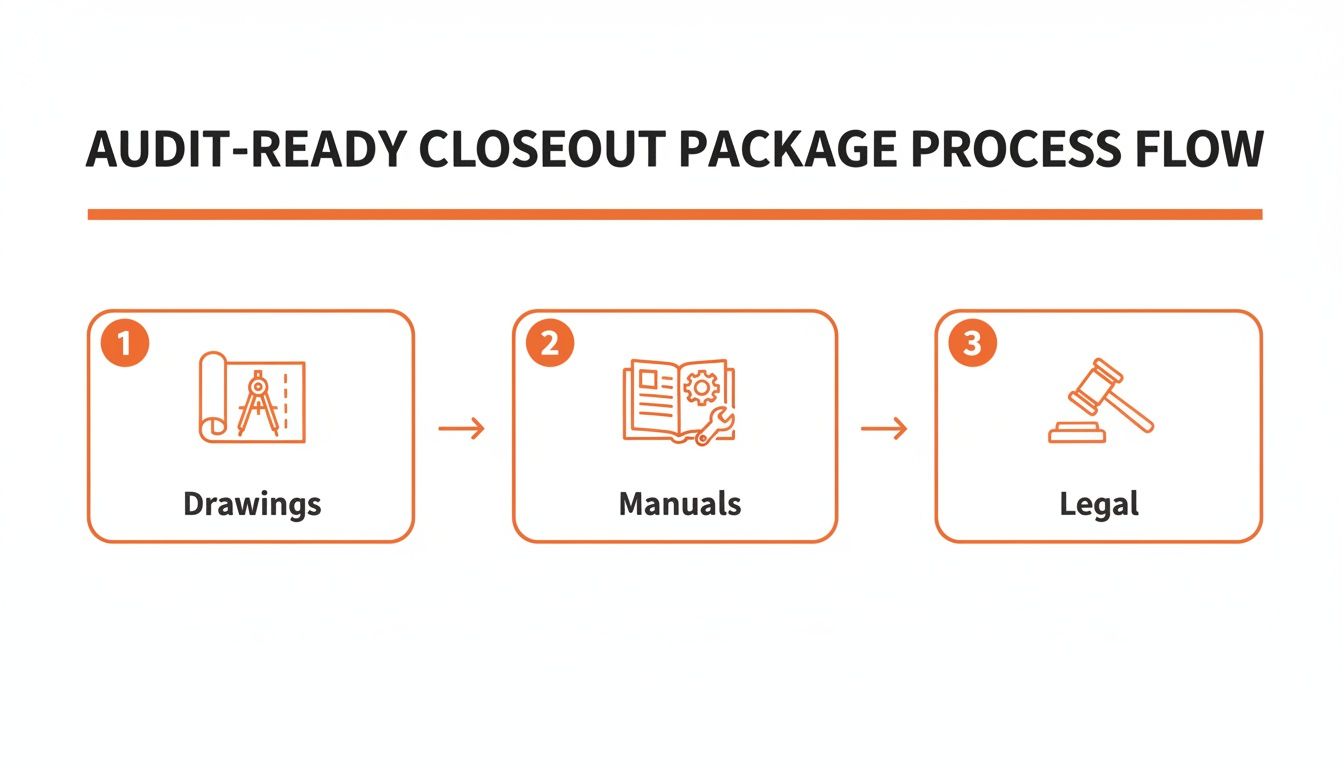
As you can see, the technical, operational, and legal documents have to be managed in parallel throughout the job—not just collected in a panic at the end. When you build your workflow from day one, every document has a clear path and a designated owner, making it nearly impossible for anything to fall through the cracks.
Sidestepping the Pitfalls That Can Derail Your Handover
Even the best-run projects can stumble right at the finish line. The handover phase has a nasty habit of exposing small oversights that can quickly blow up into major headaches, holding up final payment and souring client relationships. But these issues aren't just bad luck—they're predictable traps that spring from disorganized data and a lack of foresight.
- Scattered data
- Late subcontractor compliance
- Inaccurate as-builts
Each is preventable with structured workflows and early enforcement.
Leveraging Technology for a Faster Closeout
Let's be honest, Paper-based closeouts are a nightmare, but the real damage starts in preconstruction. Manual "clause hunting" through dense RFPs is a massive time sink that triggers a ripple effect of delays and chaotic handovers.
Modern automation solves this by delivering cited extractions with 95%+ accuracy in just 72 hours. By eliminating manual review, preconstruction teams save an average of 23.5 hours per project. This shift allows your experts to stop acting as document hunters and start focusing on high-value, competitive bidding.
From Manual Lists to Automated Registers
Manual registers miss items buried deep in specs. Automated extraction creates a complete, structured closeout plan before construction starts—eliminating end-stage chaos.
Tackling the Safety Compliance Burden
The administrative weight of safety compliance is another area where technology makes a real difference. Think about the time spent compiling, verifying, and organizing Job Hazard Analyses (JHAs) from every single subcontractor. It's a huge task that can easily hold up the final handover.
Today’s solutions can automatically pull out all safety requirements and generate pre-populated JHA tables that are already mapped to standards like OSHA. Automated JHA extraction mapped to OSHA standards replaces manual tracking with a clean, auditable safety trail—without slowing the team.
The Financial and Strategic Impact of Digital Closeouts
The move to digital document management isn't just a trend—it's a massive industry shift. The global push for digital construction closeout documents is being fueled by construction management software, a market that’s projected to explode from 7.5 billion to 17.9 billion by 2035. This growth highlights just how badly the industry needs to get more efficient. After all, bad data costs construction $1.8T globally, with 14% of rework traced to poor handover information. Digital closeout isn’t optional—it’s operational defense.
Turning Project Closeout Into a Competitive Edge
A flawless closeout is more than just checking boxes at the end of a job; it's the final, lasting impression you leave with a client. For far too long, contractors have treated this phase like a painful administrative afterthought—a frantic scramble to dig through old RFP clauses and hunt down paperwork from subs. That reactive scramble doesn't just erode trust; it holds up your final payment.
A flawless closeout is your final impression. Fast payment, zero disputes, and organized delivery win repeat work.
Saving 23.5 hours per project compounds into real margin over a year.
Can Technology Genuinely Help with the Closeout Mess?
It absolutely can, if it removes manual clause hunting, builds submittal registers automatically, and enforces compliance early.
That’s exactly what Halozen.ai does: delivering cited clause extractions, audit-ready submittal registers, and JHAs in 72 hours, so contractors close faster and get paid sooner.
Stop the Paper Chase. Start Closing with Confidence.
A flawless closeout is your final, lasting impression. By mastering the workflow from the bid stage, you protect your bottom line, satisfy your clients, and move on to the next project with confidence.