

Preconstruction teams often struggle with RFP overload, clause hunting, and safety compliance burdens, adding an average of 23.5 hours per project and jeopardizing timelines and budgets. That’s where Halozen.AI makes the difference—delivering cited clause extractions, Job Hazard Analyses (JHAs), and submittal registers in under 72 hours with 95%+ clause coverage, turning RFI backlogs into streamlined workflows.
An RFI, or Request for Information, is a formal query submitted by contractors or subcontractors to clarify design details, contract clauses, or material specifications before any work commences. This simple step can save months of headaches down the line.
What Are RFIs In Construction

An RFI is your project’s question mark turned into a record. Contractors send these when:
- Drawings omit key specs
- Contract language feels vague
- Material choices aren’t spelled out
Common RFI Timelines
- Issuance• Submitted on Day 1 of spotting unclear specs
- Response• Answers arrive within 3–5 business days to keep work flowing
- Closure• Wrapped up in under two weeks, so the project stays on track
“An early RFI is like a safety net—it catches issues before they become expensive mistakes.”
Unanswered RFIs can stretch a schedule by as much as 10%. Quick turnarounds mean fewer downtime hours and better budget control.
Project managers or design leads usually review incoming RFIs. Including clear questions and attaching relevant drawing excerpts can slash the back-and-forth.
RFIs Beyond Construction
In radio engineering, RFI stands for Radio Frequency Interference—an entirely different beast that affects signal clarity and carries staggering economic weight.
For instance, in 2021, the FCC’s C-Band auction for 5G spectrum shattered records, drawing over $81 billion in bids as carriers fought for signal clarity. While the 2021 auctions were significant, the stakes have only escalated; the FCC has scheduled a new major spectrum auction (Auction 113) for June 2026 to meet the massive demand for 5G and 6G clarity. For more on the upcoming billion-dollar bids, check out the latest FCC auction schedule."
Understanding Key Concepts Of RFIs
Think of an RFI as a detective’s magnifying glass—spotting hidden ambiguities in drawings and contracts before they turn into big headaches. By asking targeted questions early, you sidestep costly rework and keep the project moving.
- Precision In Questions reduces schedule risk.
- Documented Answers build an audit trail.
- Clear RFIs save time and money.
Unlike change orders or submittals, RFIs aren’t about approving work or materials. Instead, they zero in on missing details—asking “What’s required?” rather than “Can we change this?”
Define Key Terms
A Request for Information is the formal nod contractors send when specs or drawings leave gaps. It’s not a transmittal (which moves documents around), and it isn’t a change order (which alters scope midstream).
- Change Order: Adjusts scope after work begins
- Submittal: Verifies material or product compliance
- Transmittal: Logs document delivery and receipt
Picking the right document means fewer mix-ups and a smoother workflow. When you know exactly where an RFI fits, you can fast-track answers and avoid surprises.
Create An RFI Mindset
Drafting an RFI resembles writing a good support ticket—you need a clear subject, enough context, and a concise question. Nail those three, and you’ll keep everyone on the same page.
“An RFI is your project safety net; it catches ambiguities before mistakes happen.”
That simple comparison ties everyday ticketing to preconstruction clarity. When each team member treats RFIs as an early warning system, budgets stay intact, and deadlines become a lot more reliable.
RFI Lifecycle Explained
The RFI process can hit a wall when estimating teams are buried under RFP overload, clause hunting, and safety compliance checks—consuming 23.5 hours per project. Halozen.AI extracts citations, generates JHAs, and delivers submittal registers within 72 hours, cutting that time and ensuring 95%+ clause coverage.
I like to picture RFIs as a relay race. Architects, subcontractors, and project managers each pick up the baton—spotting gaps, drafting questions, routing for review, and weaving answers back into the plan. When you know the phases—Identify, Ask, and Align—every handoff stays smooth.
- Identify ambiguity in drawings or specs
- Ask focused questions referencing contract clauses and safety triggers
- Align teams by routing RFIs to the right stakeholders
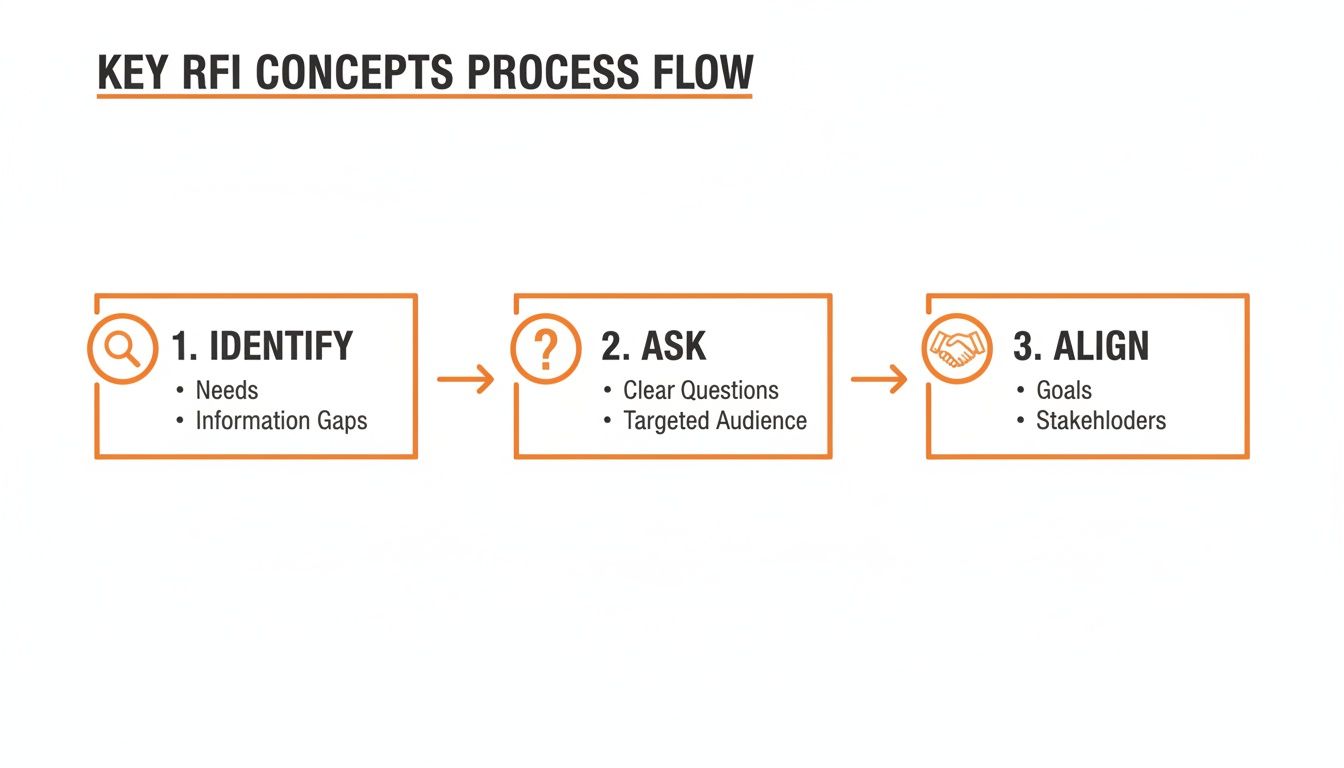
By spotlighting Identify, Ask, and Align, the graphic shows where delays creep in and how clear inputs can trim review time by up to 50%.
Typical RFI Structure And Examples
Every RFI begins with a unique RFI number and a submission date. These identifiers link each question back to project logs and audit trails, so you always know when and where it originated.
In the header, you’ll see fields for the originator, the assigned reviewer, and the due date. Setting deadlines—often 3–5 business days—keeps approvals on track without unnecessary delays.
Next comes the narrative box, where you spell out the issue or question. Including drawing callouts, page numbers, or snippets gives reviewers the context they need. Attaching photos or spec excerpts makes responses faster and more accurate.
Researchers warn that terrestrial RFI can disrupt satellite systems like GPS and weather monitors, causing steep economic and safety costs. Read the aerospace.org analysis on satellite RFI risks.
Key Form Fields
- RFI Number and Submission Date: Tracks issuance and timelines.
- Originator and Reviewer: Clarifies who asked the question and who’ll answer it.
- Question Narrative: Explains the ambiguity or missing information.
- Referenced Drawings: Points directly to plan sheets, bubbles, or callouts.
- Attachments: Adds photos, spec excerpts, or any supporting evidence.
- Response Section: Captures official answers and sign-offs.
How To Fill An RFI
- Assign the RFI number and record the submission date.
- Identify the responsible reviewer.
- Draft a concise question with enough background to avoid follow-ups.
- Attach relevant drawing excerpts or photos.
- Record the response and close the loop.
Halozen.AI auto-populates these fields, generates JHAs, and produces submittal registers within 72 hours, achieving 95%+ clause coverage and saving 23.5 hours per project.
An organized RFI workflow means nothing slips through the cracks—and preconstruction teams stay aligned. Audit teams rely on this mapping to verify every query is answered, cutting schedule risks by up to 10%. Integrating RFI data into project dashboards shines a light on recurring gaps and keeps stakeholders in sync.
Best Practices You Need To Know
Preconstruction teams often grapple with RFP overload, endless clause hunting, and safety‐compliance headaches—challenges that eat up hours and introduce risk at every turn.
Halozen.AI delivers cited clause extractions, job hazard analyses (JHAs), and submittal registers in under 72 hours, achieving 95%+ clause coverage and reclaiming 23.5 hours per project.
Understanding RFIs means your team asks the right questions, avoids confusion, and keeps projects moving smoothly.
- Craft concise, context-rich questions to minimize back-and-forth.
- Cite contract clauses with pinpoint accuracy for a solid audit trail.
- Maintain consistent version control so every edit is logged.
- Bundle related queries to reduce stakeholder touchpoints.
- Set realistic due dates that vendors can actually meet.
Watch your RFI metrics like a hawk. Spotting patterns early lets you tweak your process for the next project.
Use data to highlight recurring issues and refine your RFI template over time.
Crafting Clear, Focused Questions
Begin each RFI with a sharp, one-line topic sentence that names the exact issue. For example, reference drawing numbers and spec sections together. That little tweak alone makes routing smoother and answers faster.
“A precise RFI question can cut review time in half,” says a seasoned estimator.
Sharper questions lead to fewer clarifications and a stronger audit record.
Bundling Queries And Version Control
Grouping similar inquiries trims multiple review loops and keeps everyone on the same page. A simple numbering scheme—RFI-001a, RFI-001b—signals related items. Meanwhile, version control captures every change so nothing vanishes in the shuffle.
- Assign unique IDs for full traceability.
- Lock attachments to specific versions.
- Archive superseded drafts while flagging active requests.
A quick review of bundled RFIs can reduce cycles by 30%. Build in buffer days when you set deadlines and agree on response timelines up front. Regular status updates ensure no one’s caught off guard.
In meteorological and numerical weather prediction systems, RFI severely undermines passive and active microwave observations, which are foundational to global forecast accuracy and economic safeguards. Learn more about radio frequency interference impacts in weather forecasting .
By weaving these best practices into your routine, you’ll cut review cycles, boost traceability, and maintain compliance. Audit responses for accuracy and share lessons learned after each project closes. With Halozen.AI automating structured RFI outputs and submittal registers in 72 hours, your projects stay on track and under budget—no matter their size.
How Tools Can Streamline RFI Workflows
Preconstruction teams often find themselves buried under a mountain of RFIs and hunting down clauses by hand. Safety checks can stall project kickoffs and drain estimator bandwidth.
Halozen.AI delivers cited clause extractions, JHAs, and submittal registers in under 72 hours, saving an average of 23.5 hours per project with 95%+ clause coverage.
Key Automation Benefits
Halozen.AI turns raw data into actionable reports almost instantly.
- Clause Extractions tied directly to contract sections
- Job Hazard Analyses (JHAs) mapped to OSHA or WHS standards
- Submittal Registers complete with trigger events and deadlines
“Automating RFI workflows saves an average of 23.5 hours per project,” says a bid manager.
That level of structure delivers 95%+ clause coverage on the first pass.
Workflow In Action
The screenshot below shows a Halozen dashboard tracking RFI status, response times, and audit trails.

You can see open RFIs, SLA clocks, and team assignments all in one place.
From there, response cycles shrink from days to just hours. Manual handoffs vanish thanks to integrations with scheduling and project platforms.
- Automated routing to architects, safety leads, and project managers
- Real-time alerts when an action is required
- Version-locked outputs maintain audit readiness
“Halozen compressed our RFI turnaround from five days to under ten business hours,” notes a preconstruction director.
Manual Vs Automated Comparison
Workflow Aspect | Manual Process | Halozen Automation |
Clause Coverage | ~60% first pass | 95%+ |
Time To Draft JHA | 10–15 hours | <1 hour |
Submittal Register | 5–8 hours | <30 minutes |
Response Cycle | 3–5 days | <10 hours |
By embedding citation-locked extractions and JHA tables directly into project management tools, Halozen.AI compresses RFI workflows and reduces risk.
Estimators can redirect 23.5 hours into high-value tasks like bid strategy. With 72-hour delivery SLAs and an audit-ready trail, RFI backlogs become a thing of the past.
- Adopt automated tools for faster, more accurate RFI handling.
FAQ About RFIs
Preconstruction often grinds to a halt when questions pile up. This FAQ cuts through the noise with practical advice on distinguishing RFIs from change orders, keeping tabs on every request, and trimming unnecessary chatter.
- Spot the difference between RFIs and change orders
- Keep RFIs organized with simple templates
- Add context up front to speed answers
What Makes RFIs Different From Change Orders?
RFIs are all about clearing up doubts before a nail is driven. Change orders, on the other hand, tweak the scope once construction is underway.
“Early RFIs act like safety nets, catching uncertainties before they trigger rework.”
How Do I Track RFI Status Effectively?
Keeping an eye on deadlines and reviewers stops RFIs from slipping through the cracks. A simple table that matches each RFI number with submission dates and names does the trick.
Numbered tracking steps ensure every request gets noticed:
- Log the RFI number and submission date
- Assign each request to a reviewer with a due date
- Update the status at every review and response stage
Tips For Reducing RFI Volume
A small tweak to your RFI template can cut redundant queries by 30%. Focus on clarity up front, and you’ll save hours later.
- Draft concise, context-rich questions
- Reference drawings or contract sections directly
- Bundle related points under one RFI number
What Details Drive Timely RFI Responses?
Reviewers respond fastest when you hand them everything they need. Include precise callouts, spec citations, and clear photos so there’s no room for guesswork.
You might also be interested in exploring pricing options to streamline your RFI workflows in our RFI pricing guide.
How Can Halozen.AI Streamline RFIs?
Halozen.AI tackles RFP overload, clause hunting, and safety compliance by delivering cited clause extractions, JHAs, and submittal registers in 72 hours with 95%+ clause coverage, saving an average of 23.5 hours per project.
Can I Reduce RFI Review Cycles With Templates?
Absolutely. Templates that prompt for attachments and spec references can shrink review loops by 40%.
- Include a dedicated section for photos and spec citations
- Highlight project codes and drawing sheet numbers
Ready to clear the backlog and reclaim your schedule? Get started with Halozen.AI now!